The UAE is taking a significant step towards digital transformation with the introduction of e-invoicing, aligning itself with more than 80 countries that have already adopted similar frameworks. However, this shift is about far more than simply replacing paper invoices with digital ones. It represents a fundamental change in how businesses exchange data, manage compliance and operate in an increasingly connected economy.
We are trying to answer the most important questions businesses are asking.
1. What is e-invoicing and why does it matter?
E-invoicing goes beyond simply digitising paper invoices. It enables real-time, structured data exchange between businesses using XML-based formats, where invoices are generated, validated and reported electronically.
This transformation helps organisations:
- Optimise cash flow
- Reduce manual errors
- Strengthen compliance
- Build trust in business-to-business (B2B) transactions
In the UAE, e-invoicing is also designed to improve VAT compliance, reduce the tax gap and support broader economic goals such as Vision 2031. It will further enable advanced capabilities like AI-driven analytics, forecasting and fraud detection.
2. When will e-invoicing be implemented in the UAE?
E-invoicing will be introduced in phases from 1 January 2027 and will apply to business-to-business (B2B) and business-to-government (B2G) transactions. Currently, business-to-customer (B2C) transactions are outside the scope.
The Federal Tax Authority (FTA) has outlined a phased implementation based on business revenue:
- Revenue more than or equal to (≥) AED 50 million
- Appoint Accredited Service Providers (ASP) by 31 July 2026
- Start e-invoicing by 1 January 2027
- Revenue less than (<) AED 50 million
- Appoint ASP by 31 March 2027
- Start e-invoicing by 1 July 2027
Businesses should assess their revenue based on their most recent accounting period to determine the applicable timeline.
3. What is the Peppol network and how does it work?
The UAE will adopt the Peppol network, a globally recognised electronic network that enables the secure, standardised and often cross-border exchange of business documents between public and private organisations.
Under this model, ASPs will act as intermediaries, ensuring invoices are correctly generated, validated, transmitted and reported to the authorities in line with regulatory requirements.
4. How are e-invoices transmitted in the UAE?
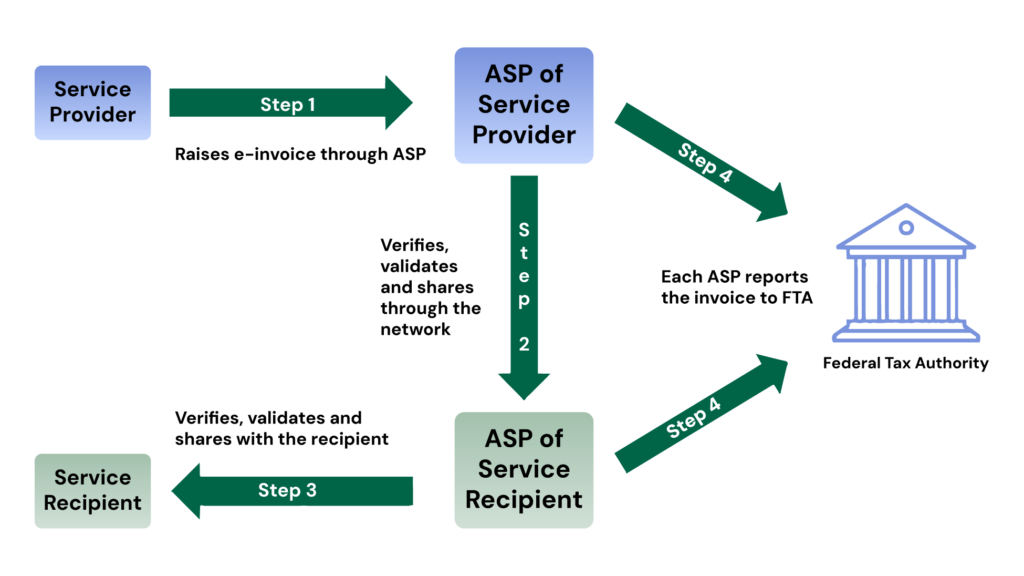
Model 1: When the recipient is part of the Peppol network
Step 1: Invoice Generation
The service provider raises the e-invoice through its ASP.
Step 2: Validation and Network Transmission
The ASP of the service provider verifies, validates and shares the e-invoice through the network with the recipient’s ASP.
Step 3: Recipient Processing
The ASP of the service recipient verifies, validates and shares the invoice with the recipient.
Step 4: Reporting to FTA
Each ASPs of service provider and service recipient report the invoice to the Federal Tax Authority (FTA).
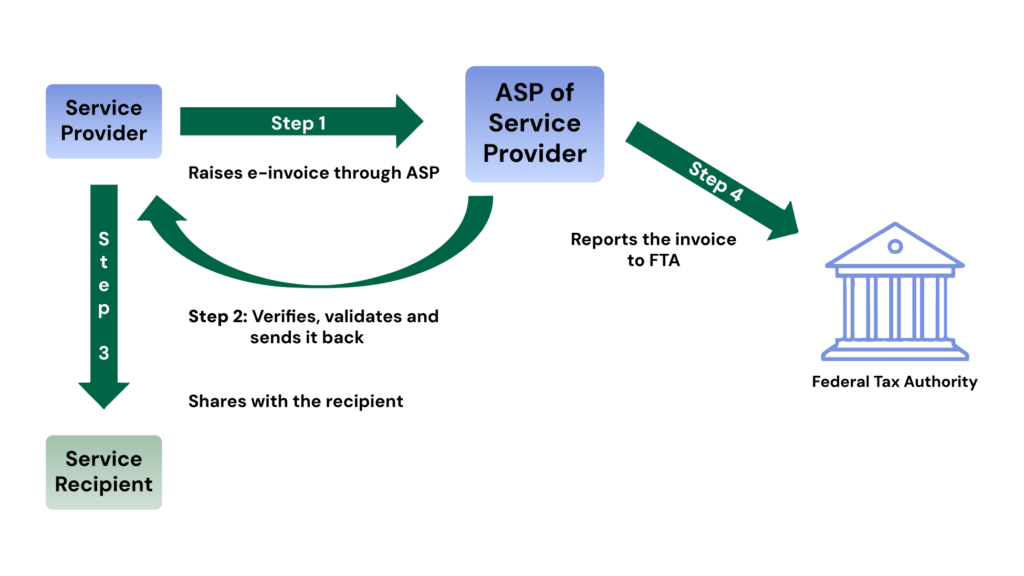
Model 2: When the recipient is NOT part of the Peppol network
Step 1: Invoice Generation
The service provider raises the e-invoice through its ASP.
Step 2: Validation
The ASP of the service provider verifies, validates and sends it back.
Step 3: Sharing with Recipient
The service provider shares the invoice with the recipient.
Step 4: Reporting to FTA
The ASP of the service provider reports the invoice to the Federal Tax Authority (FTA).
5. What should businesses do to prepare?
Preparation will be critical to ensure compliance and avoid disruption. Businesses should:
- Evaluate current invoicing and ERP systems
- Identify and appoint an ASP
- Align internal processes with structured data requirements
- Train teams on new workflows and compliance standards
6. How can Evorit support your e-invoicing journey?
Transitioning to e-invoicing requires both strategic planning and execution.
As a Finance, Accounts and Tax consulting partner, Evorit has been helping organisations with:
- Assessing e-invoicing readiness and defining implementation roadmaps
- Align systems and processes with regulatory requirements
- Support in seamless integration with ASPs and Peppol frameworks
- Drive end-to-end compliance with minimal disruption